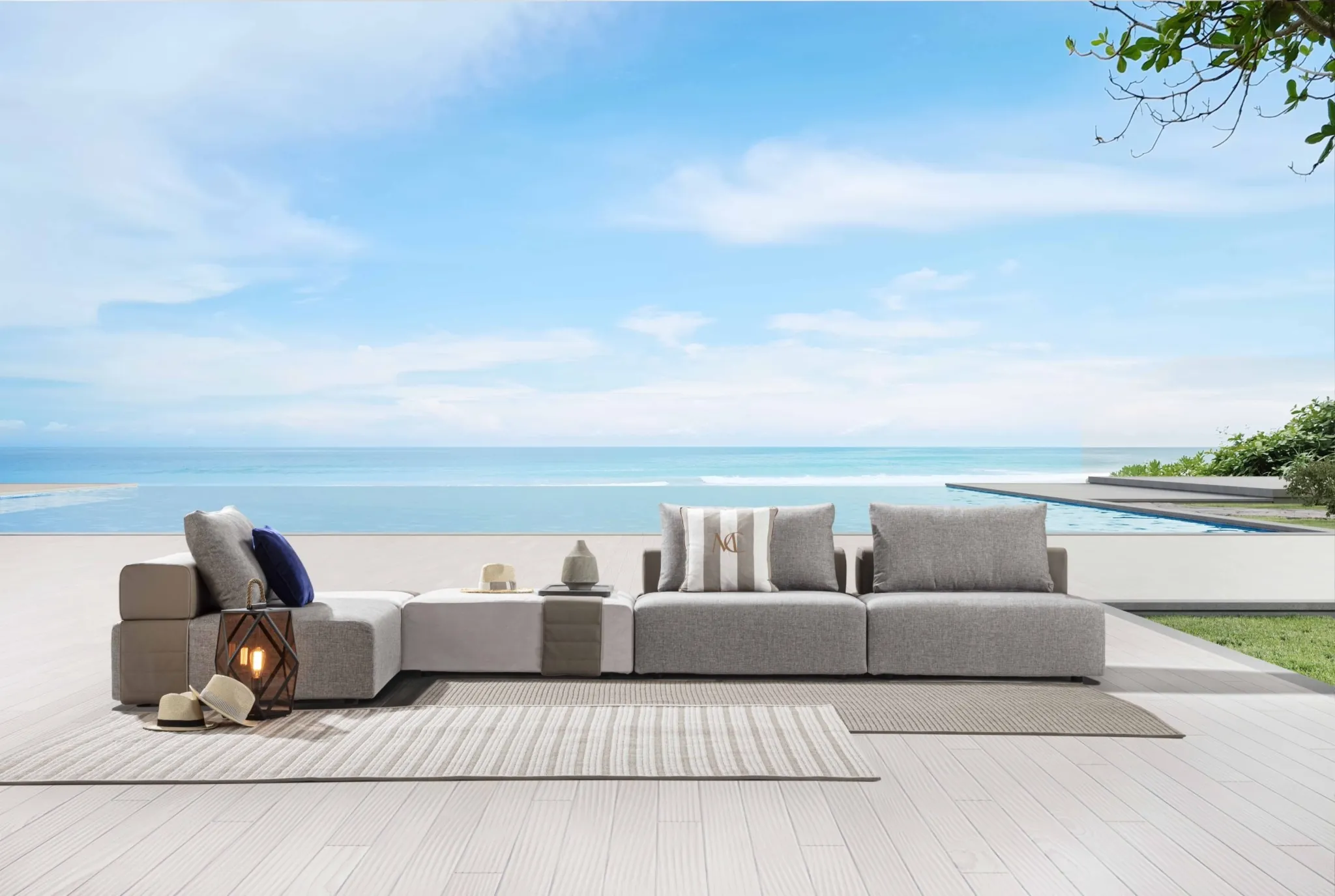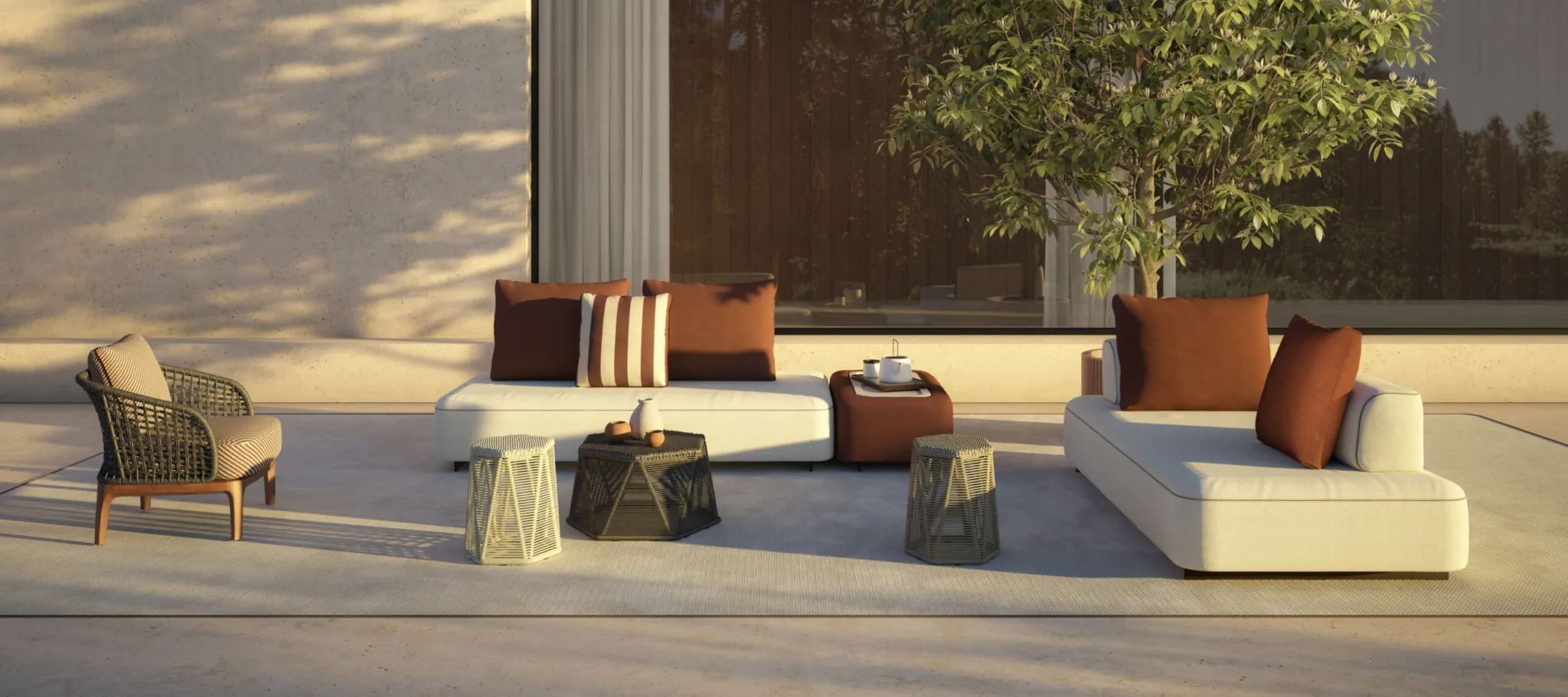
A modular outdoor sofa grows to fit a terrace, where a fixed sofa makes the terrace fit it. Meroni & Colzani, the two workshops in Cabiate that have shared a name since the 1970s, make two modular systems for outside. Pangea works with curved and straight modules. Linosa works with two elements and a set of bands. Both let you start small and add pieces later.
pangea, curves and straights
Pangea combines curved and linear modules, and you can join them in any order. The factory describes layouts that change over time, from a classic straight sofa to a fluid, enveloping curve. The backrests come fixed or removable. With the backrest off, a module turns into a seat you can use from any side, which the factory calls a convivial island.
That removable back makes Pangea good in the middle of a terrace. A sofa with backs faces one way. A group of backless modules faces everywhere, and people sit on it the way they sit on a garden wall. The outdoor version keeps the modules and the tailoring for use outside. See the Pangea family.
linosa, two elements and bands
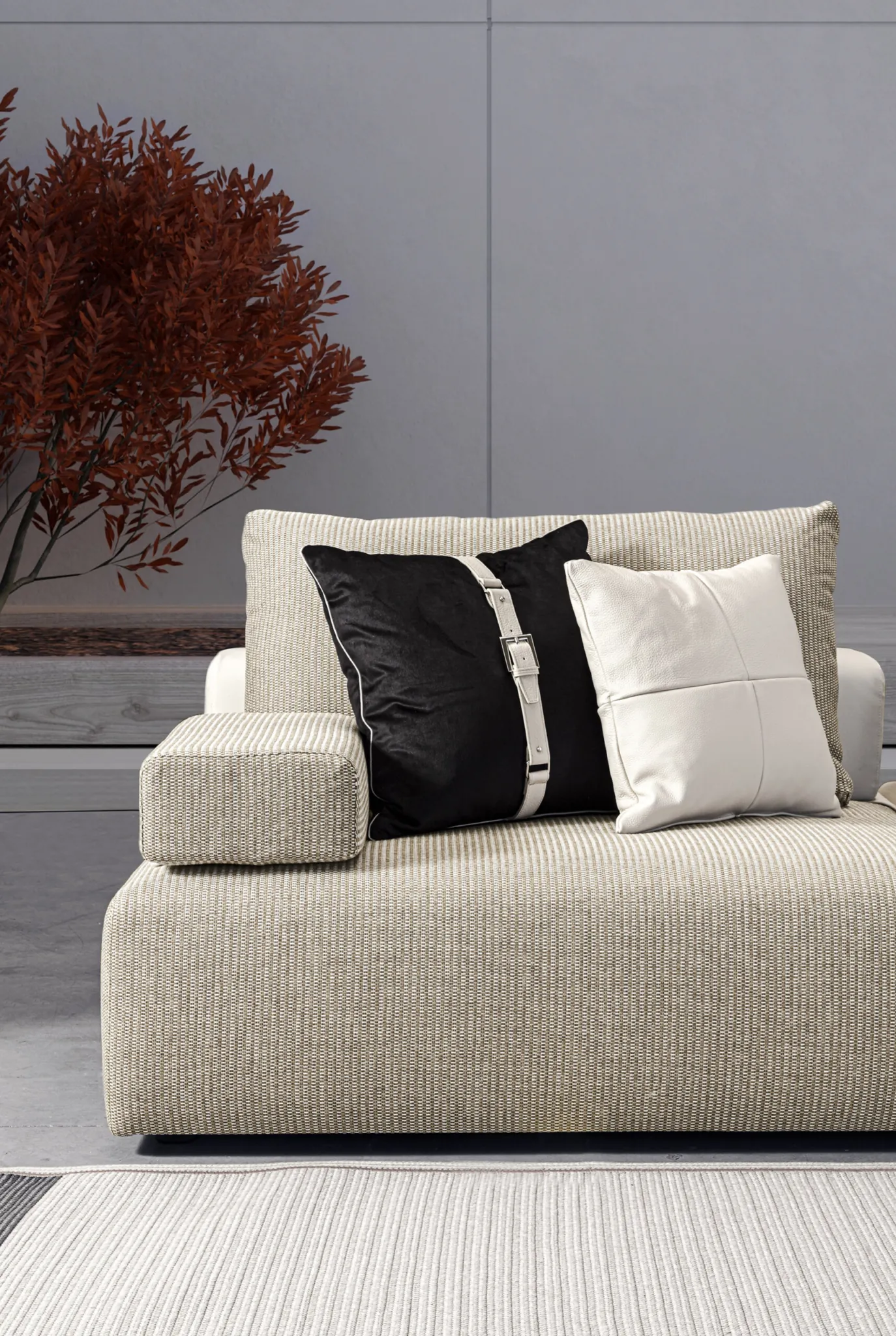
Linosa keeps it simpler. There are two elements: a seat, and a seat with a backrest. Around them you add armrests, bands, and bands with an integrated table top in stone or wood. The base stays plain on purpose, and the factory says that plainness lets you try unusual materials and color pairings.
A band with a top turns into a table without a table. Put one between two seats and you have a place for a glass at hip height, fixed to the sofa so it stays where you put it. See the Linosa family.
counting modules
Start with the wall or the view. Measure the run you want to fill and draw it on paper with the doors and paths marked. Each path needs about 3 feet, and a sofa that blocks a door fails on the first evening.
Then pick the shape: a straight run, a corner, an island or a curve. For Pangea, count straight modules for the runs and add curved ones where the line turns. For Linosa, count seats with a backrest along the walls and plain seats where the sofa opens, then decide where the arms and bands go.
the depth question
Outdoor seats tend to run deep, and depth decides how people sit. A deep seat invites you to tuck your legs up with a book. A shallower one suits dinner guests who sit upright and talk. Ask us for the depth of each module with the quote; the factory does not publish dimensions, and we would sooner give you the right number than a guess.
Cushions add a layer to plan for. Loose back cushions let you change a module's shape, and you need a place to store them in winter. Fixed backs mean less to carry in when rain comes.
Fabric choice follows use. A family with children and a dog wants a cover that shrugs off mud and wipes clean; a quiet terrace can take a softer weave. The factory offers a range of outdoor fabrics, and we send swatches of the ones open on the modules you choose so you can see them in your own light.
counting modules
-
01 / 02
Pangea
- Straight run for a wall
- Straight modules, backrests fixed
- Corner
- Straight modules and a curved one at the turn
- Island in the middle
- Modules with removable backrests, open on all sides
- Curve around a fire pit
- Curved modules in sequence
-
02 / 02
Linosa
- Straight run for a wall
- Seats with backrest in a row, armrests at the ends
- Corner
- Seats with backrest on two sides, a plain seat in the corner
- Island in the middle
- Plain seats with a band and a top between them
- Curve around a fire pit
- Not the natural choice: Linosa is straight
living with it
The strength of a modular sofa shows in year two. You move house, the terrace changes, the family grows, and the modules rearrange. Keep a sketch of the layouts you like; it saves an argument each spring.
Sketch the terrace, mark the doors and the direction you look out, and say whether you lean toward Pangea or Linosa. We come back with a module count, the fabrics open on those pieces, the lead time the workshop gives, and a price for each Meroni & Colzani module.